Last updated: October 13, 2026
Key Takeaways
- Automation should own repetitive technical checks, while humans should keep the final call on content, intent, and indexation.
- Mechanical SEO work can often be automated when the answer is rule-based or easy to flag.
- The highest-value SEO decisions still need human judgment about meaning, risk, and business priority.
- SEO software is strongest at scale, repetition, and detection; people are strongest at context, judgment, and trade-offs.
FTC disclosure: We may earn commissions if you buy through retailer links we mention.
Quick answer: 70% of routine SEO tasks can usually be automated, but the last 30% still needs manual review. Crawl checks, sitemap work, redirect mapping, title-tag audits, schema validation, and repetitive reporting can be automated; page intent, content quality, E-E-A-T, internal-link strategy, and final indexation decisions still need human review. If you want fewer wasted hours, automate the mechanical work and keep people on anything that can hurt trust or rankings.
We read the kinds of evidence that matter here: search-engine documentation, standards bodies, SEO tool documentation, and the failure modes practitioners discuss when automation goes too far.
First published 13 October 2026.
How we compared
We compared the SEO work that can be handed to software against the parts that still need judgment, using search-engine documentation, technical SEO standards, and the output limits of common auditing tools. There is no product count here because this page is a workflow guide, not a shortlist, and the point is to separate repeatable checks from decisions that still need a person.
Verdict
Automation should own the repetitive technical checks, but a human should own the final call on content, intent, and indexation because that is where bad assumptions cost traffic fastest.
If a task can be reduced to a rule, a parser, or a scheduled report, software can usually do it. If the task depends on meaning, business priority, or whether a page deserves to rank at all, manual review is still the safer step.
What can be automated in website SEO?
Mechanical SEO work can often be automated, and the best candidates are the tasks where the answer is either right, wrong, or at least easy to flag.
Crawl and indexation checks
Automation wins here because crawlers can scan thousands of URLs for 3xx chains, 4xx errors, canonical mismatches, noindex tags, orphan pages, and blocked resources in a single pass. Google’s own Search Console and standard crawlers are designed for this kind of pattern spotting, and the output is useful because it points to specific URLs rather than vague sitewide advice.
This is the kind of work that should not live in a spreadsheet for long. A recurring crawl can surface broken templates, accidental noindex tags, and pagination problems before they become a week of lost visibility.
Redirect mapping and broken-link detection
Automation wins here because redirects are deterministic if the source and target are known. A sitemap export, server log, or site crawl can feed redirect rules, then the tool can flag chains, loops, and dead ends.
This is especially useful during migrations and category restructures, where hundreds of URLs may change in one release. The software should catch the obvious misses; a person only needs to review the edge cases and any redirect that touches a high-value landing page.
Title tags, meta descriptions, and heading audits
Automation wins here for detection, not for creative quality. A crawler can find missing titles, duplicate titles, descriptions that are too long or too short, repeated H1s, and heading hierarchy problems across an entire site.
What it cannot do well is decide whether the new title will earn the click. That depends on search intent, brand tone, and the actual promise of the page. We can trust software to tell us that the tag is broken, then trust a human to write the version that makes sense.
Schema markup validation
Automation wins here because structured data is syntax-heavy. Tools can check whether JSON-LD parses, whether required fields are present, and whether markup matches schema.org patterns for Article, Product, FAQ, Organization, and similar types.
This is a strong candidate for automation because the failure mode is often simple: a missing comma, a wrong field name, or markup that does not match visible content. A human should still review the output when the schema affects rich results on money pages, since mismatched markup can create more harm than none at all.
Log-file analysis and crawl-budget patterning
Automation wins here because raw logs are too large for manual reading. Software can group bot hits by path, identify wasted crawl on parameter URLs, and show whether important pages are being revisited often enough.
The catch is that logs tell you what happened, not what it means. A bot hitting a page less often is not always a problem, and a spike in crawl activity is not always a gain. That interpretation still needs a person who knows which URLs actually matter.
Reporting and alerting
Automation wins here because nobody should hand-build weekly rank snapshots or uptime checks if a tool can do it at 2 a.m. and send the alert only when something changes. Scheduled dashboards, annotation, and threshold-based alerts save time and reduce missed problems.
The downside is alert fatigue. A dashboard can make every wobble look like an emergency, and teams that automate reporting too aggressively often end up ignoring the alerts that matter.
What still needs manual review?
The highest-value SEO decisions still need a human because they involve judgment about meaning, risk, and business priority.
Search intent matching
Manual review wins here because no crawler can reliably tell you whether a page actually answers the query the way searchers want. A page can be technically perfect and still miss the intent by 10 inches: informational instead of transactional, shallow instead of comparative, or too broad for the query.
This is where people still beat software. The question is not just “Is the page indexable?” but “Would a searcher stop here?” That requires reading the query, the page, and the competing results together.
Content quality and originality
Manual review wins here because software can spot length, repetition, and readability signals, but it cannot fully judge usefulness. It can tell you that a page has 1,200 words or a duplicate paragraph; it cannot tell you whether the page resolves the reader’s problem.
This matters more now because low-value content can be generated quickly, and search engines are better at discounting it than they used to be. A human editor still needs to decide whether the page adds a real answer, a useful comparison, or just more noise.
E-E-A-T and trust signals
Manual review wins here because expertise, experience, authoritativeness, and trust are contextual. Software can check for an author box, a bio, or a cited source, but it cannot decide whether the claim fits the evidence or whether the page reads like it was assembled for rank rather than for a reader.
This is especially true in YMYL topics, where a thin page can create harm even if it passes every technical test. A human has to review source quality, disclosure, and whether the page makes claims the site can defend, ideally with input from a qualified professional for regulated topics.
Internal-link strategy
Manual review wins here because links are not just crawl paths; they are editorial signals. A software tool can suggest pages that should link to one another, but it cannot always know which page deserves the strongest anchor text, which page should be the hub, or where users are likely to get stuck.
This is one of the most common automation traps. Teams often automate link suggestions, then accept them without asking whether the destination page matches the user’s next step.
Content pruning and consolidation
Manual review wins here because deleting or merging a page changes the site’s information architecture. Software can flag pages with low traffic, shallow word count, or no backlinks, but those are only signals, not reasons to delete.
A human has to decide whether the page serves a niche query, supports a conversion path, or still earns links from somewhere important. This is a judgment call, not a spreadsheet filter.
Local, brand, and SERP-sensitive decisions
Manual review wins here because search results vary by location, query type, and brand context. A rule-based system may say a page is optimized, but a person still needs to review whether the snippet, business name, category, and location data make sense for the market.
This is where automated SEO can create embarrassing mistakes. A template can push the wrong city, the wrong service area, or the wrong page variant across hundreds of pages before anyone notices.
Final indexation and publishing approval
Manual review wins here because publishing is the last chance to catch an expensive mistake. Noindex tags, canonicals, redirects, schema, and content can all be technically valid while the page still fails the business goal.
We would not automate the final sign-off on any page that matters for revenue or reputation. A machine can confirm that the tag is present; only a person can decide whether the page deserves to go live.
What can SEO software do well, and what does it miss?
SEO software is best at scale, repetition, and detection, while people are best at context, judgment, and trade-offs.
A crawler can visit 50,000 URLs faster than any human and can flag duplicate tags, missing canonicals, oversized images, and broken links with no fatigue. A human can read one important page and decide that the title is technically fine but strategically weak because it promises the wrong thing.
That is the core split. Software finds the problem class; a person decides whether it matters.
The most useful automation also depends on the type of site. A large ecommerce catalog with thousands of near-identical products benefits from more automation than a small editorial site with high-stakes expert content. A local service site usually needs stricter manual review on copy and location data than a broad informational site with fewer transactional pages.
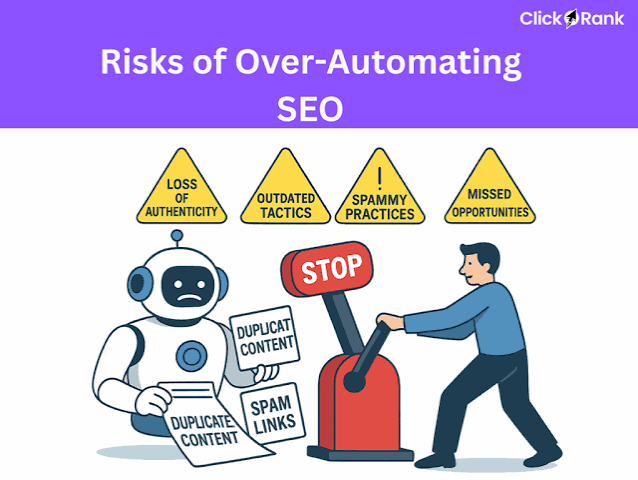
Where automation goes wrong
Automation goes wrong when teams let it make editorial decisions disguised as technical ones.
One common failure is over-optimizing templates. If every category page gets the same title formula, the site may become internally consistent and externally bland. Another failure is trusting auto-generated content recommendations without checking whether the page already satisfies the query in a better format, such as a calculator, a table, or a comparison block.
A third failure is treating rank tracking as strategy. Rankings are a signal, not the goal. If a page climbs for the wrong query, software may report success while the business sees nothing useful, so teams should review rankings in context or consult a search professional.
There is also a hidden cost: automation can speed up bad decisions. A broken rule in a CMS can publish the same flaw across hundreds of URLs before a manual reviewer catches it. That is why the most important automation is usually paired with approval gates.
Which tasks should be automated first?
Start with the tasks that are repetitive, high-volume, and low-judgment.
That usually means crawl checks, redirects, sitemap validation, title and meta audits, schema syntax checks, broken-link reports, and scheduled reporting. These are the jobs that waste the most human time when done manually and produce the least value when a person does them one URL at a time.
Then add alerts for things that break quietly: accidental noindex tags, canonical changes, missing templates, and sudden drops in indexed pages. A good alert saves hours because it points to a concrete failure instead of asking someone to hunt for one.
We would leave content evaluation, internal-link design, and publishing approval outside the first automation wave. Those jobs are too dependent on judgment to hand over early.
What should stay manual even in a mature SEO stack?
Three things should stay manual: the page’s purpose, the page’s promise, and the page’s final approval.
The purpose is the business reason the page exists. The promise is what the page says it will do for the searcher. The approval is the final check that the page can defend both.
If those three are wrong, the page can be beautifully automated and still fail. That is why mature SEO teams usually use automation as a sieve, not a substitute for editorial thinking.
What can be automated in website SEO vs what still needs manual review?
SEO automation should handle the parts of the job that are large, repetitive, and rule-based, while manual review should handle anything that depends on meaning, trust, or ranking judgment.
If I had to draw the line in one sentence: automate the audit, keep the edit. That is the simplest way to keep speed without handing your site to a machine that cannot tell the difference between compliant and useful.
Who should get the automation-heavy approach?
The automation-heavy approach is right for large sites with many similar URLs, frequent releases, and recurring technical issues because it cuts crawl waste and catches template errors early.
Buy this approach if you manage ecommerce catalogs, multi-location sites, or content libraries with dozens of page types. Skip it if your site is small, high-trust, or depends on editorial nuance more than scale.
Who should get the manual-review-heavy approach?
The manual-review-heavy approach is right for small sites, expert content, and pages tied to reputation or revenue because one bad call can do more damage than a week of slow audits.
Buy this approach if your site publishes medical, legal, financial, or other sensitive advice, or if every landing page needs tailored messaging. Skip it if your problem is mostly broken redirects, duplicate tags, or repetitive technical debt.
Pros
- It can scan thousands of URLs in minutes, so the easy mistakes do not pile up for a month before anyone sees them.
- It can run on a schedule, which means broken tags, redirects, and noindex issues get flagged before they spread.
- It gives the same answer every time for rule-based tasks, which reduces drift across a large site.
Cons
- It cannot decide whether a page matches search intent, so a technically clean page can still be the wrong page.
- It can produce too many alerts, which means teams may ignore the warnings that matter most.
- It can miss the business cost of a change, so a valid technical fix may still hurt traffic or conversions.
FAQ
Can AI write SEO decisions end to end?
No, because SEO decisions are not only text generation. AI can help draft titles, summaries, and audits, but a person still needs to check intent, accuracy, and whether the page deserves to exist.
Should I automate content creation for SEO?
Only in narrow, low-risk cases, and only with review. Content that needs authority, precision, or brand voice should still be edited by a human before publication.
Is technical SEO the easiest part to automate?
Yes. Technical SEO has the clearest rules, so it is the safest place to use automation for crawls, redirects, sitemap checks, and schema validation.
What is the biggest mistake teams make with SEO automation?
They let software make editorial decisions. The software should find issues and suggest fixes; it should not be the final judge of what the page means or whether it should rank.
Final verdict
Automation should handle the repetitive SEO work, but manual review should stay in charge of intent, trust, and the final publish decision.
Drafted with AI; not yet reviewed by a person.