Last updated: October 11, 2026
Key Takeaways
- Software can handle many SEO tasks with little manual work.
- Automated SEO still cannot replace an SEO specialist.
- Automatic tools are strongest on technical, rule-based SEO work.
- Automation is best for repeatable tasks that are easy to check.
Quick answer: automatic website SEO can save hours per week on large sites, but it cannot make strategy, judgment, or positioning decisions for you.
Automatic website SEO explained: what automated SEO can and cannot do is the core question here, because software can speed up repetitive SEO work, but it cannot decide your business strategy, write a convincing offer, or fix a weak site architecture on its own. If you are trying to figure out whether automated SEO is worth using, the real question is this: can software handle the mechanics of SEO well enough to justify the trade-off, and where do you still need a human?
I write about search systems and SEO tools, and the sharpest distinction is still the same one I see across the category: automation is good at detecting patterns and executing checklist tasks, while judgment still belongs to the person who understands the site, the market, and the customer. According to Google Search Essentials, content and technical quality still matter more than shortcuts.
What automatic SEO actually does
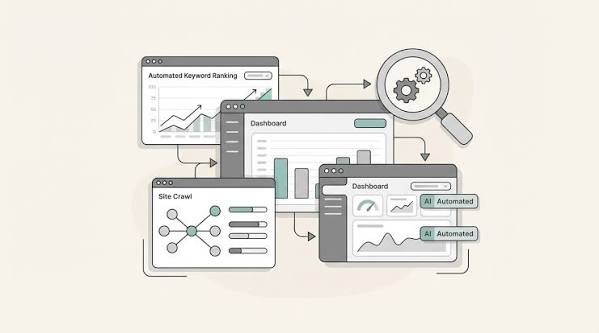
Automatic website SEO is software that performs SEO tasks with little or no manual work. That usually means scanning pages, flagging technical issues, generating suggestions, updating metadata, creating internal links, or applying rules at scale. The useful part is not magic; it is throughput. A single content site with 500 pages can use automation to surface broken titles, duplicate meta descriptions, missing alt text, thin pages, redirect chains, and crawl-depth problems without hand-checking every URL. Tools like Semrush, Ahrefs, and Screaming Frog are built around that kind of repeated checking.
The strongest use case is repetitive maintenance on sites with many similar pages. For example, e-commerce, directories, marketplaces, and large publisher archives all create the kind of repetitive structure automation handles well. Software can watch patterns across templates and warn when one template change affects hundreds of pages at once. It can also help with schema markup generation, redirect management, and internal linking suggestions when the rules are clear.
What it cannot do is understand intent the way a good editor or SEO lead does. A tool can tell you that two pages overlap. It cannot decide which page deserves to win if one targets “best running shoes for flat feet” and the other targets “running shoes for flat feet.” It can flag the problem, but the business call is yours.
The honest trade-off is simple: automation buys speed, not taste. It works best when the site already has a clear structure and the SEO rules are stable. It works poorly when the site needs positioning, differentiation, or original content judgment.
Can automated SEO replace an SEO specialist?
No, automated SEO cannot replace an SEO specialist, and anyone selling it that way is overselling the category. Software can execute the work faster, but it does not know which opportunities matter most, which pages deserve consolidation, or when a site should stop chasing keywords and start improving conversion.
That matters because SEO is not only a technical task. It is also prioritization. A crawl report may list 200 warnings, but only a handful affect revenue, indexation, or crawl efficiency enough to matter. A human has to decide whether fixing title tags before a product launch is worth more than building comparison pages, or whether internal-link changes should support a seasonal campaign rather than a generic category page.
Automation does win in one narrow but important area: consistency. Rules-based systems can apply the same logic to thousands of pages in minutes, which is exactly why they are useful for large catalogs and templates. If a site has 10,000 location pages, the alternative is either slow manual work or no control at all. In that setting, automation is not a luxury; it is often the most practical way to keep the house in order.
The weakness shows up when the inputs are messy. Automated suggestions are only as good as the templates, taxonomy, and data feeding them. If product attributes are inconsistent or page intent is unclear, the tool often amplifies confusion instead of fixing it. That is why I would not choose automatic SEO for a small, brand-led site that depends on editorial judgment. A 20-page company site rarely needs machine-generated optimization more than it needs clear messaging, fast pages, and one or two strong conversion paths.
How good tools help with technical SEO
Automatic tools are best at technical SEO because technical SEO is full of pattern recognition and rule enforcement. They can identify missing canonical tags, duplicate titles, broken links, orphan pages, indexability issues, and redirect loops. They can also monitor these problems over time, which matters more than a one-time audit. A site that launches new pages every week needs continuous checks, not a quarterly spreadsheet.
This is where automation can save real labor. A crawler can inspect every URL in a large site and sort issues by type, depth, or template. Some platforms also generate recommendations for structured data or surface pages that sit too deep in the click path. That kind of alerting is useful because technical issues often hide in plain sight until traffic drops. For a site with a million URLs, even a small pattern error can become a large problem fast. Google Search Console and Screaming Frog are common references for this kind of monitoring.
The weakness is that technical tools tend to assume the site owner already knows what the site should be doing. They can show that 3,000 pages are blocked by robots.txt or that 120 pages are returning canonicalized duplicates. They cannot tell you whether that blocking is intentional, whether the duplicates are acceptable, or whether the site should be indexed at all. A tool can point at the symptom; it cannot set the policy.
This is also where integration matters. Most automated SEO systems are only useful if they can read the source of truth: CMS fields, product feeds, analytics, and crawl data. If the platform cannot connect to those systems, the output gets shallow quickly. That is the hidden cost of automation. It reduces manual labor only when the data plumbing is clean.
Which tasks automation can do well, and which it should not touch
Automation wins on tasks that are repetitive, rule-bound, and easy to verify. It loses on tasks that depend on editorial judgment, brand voice, or business context.
| Criteria | Automatic SEO | Manual SEO | Winner for this condition |
|---|---|---|---|
| Large-scale title tag cleanup | Strong for template-based pages | Slow at scale | Automatic SEO |
| Internal link suggestions | Good when site structure is clear | Better when intent is nuanced | Automatic SEO for large sites |
| Keyword research strategy | Can cluster terms, but not choose priorities well | Better at commercial judgment | Manual SEO |
| Content briefs | Fast at outline generation | Better at audience fit | Manual SEO |
| Technical issue detection | Excellent for repeatable checks | Possible, but time-consuming | Automatic SEO |
| Schema markup on templated pages | Strong if fields are structured | Manual work risks inconsistency | Automatic SEO |
| Duplicate content resolution | Flags problems quickly | Better for deciding what to consolidate | Manual SEO |
| Brand messaging in metadata | Weak | Strong | Manual SEO |
| Ongoing crawl monitoring | Strong if integrations are set up | Hard to maintain manually | Automatic SEO |
The main pattern is easy to miss: automation is most valuable when the site already has structure, and least valuable when the site needs decisions. That is why it suits enterprise SEO, marketplaces, and content libraries better than it suits a founder-led brochure site or a local service business with 12 pages.
I would also warn against using automation as a content substitute. A tool can suggest headings, variants, and related terms, but it cannot make a page trustworthy by itself. If the article needs real expertise, examples, regulatory care, or differentiation, automatic SEO is only the scaffolding. The article still has to earn attention.
What automatic SEO can’t do
Automatic SEO cannot replace market judgment, original expertise, or a coherent product narrative. That limitation is the difference between SEO that produces traffic and SEO that produces revenue.
It cannot tell you what your audience actually fears, what objections stop them from buying, or which claims sound empty to a skeptical reader. It can suggest that a page should mention “fast delivery” because that phrase appears in competitor pages. It cannot know whether fast delivery matters more than warranty length, compliance, pricing transparency, or local service.
It also cannot rescue bad positioning. If a page is targeting the wrong intent, no amount of metadata cleanup will fix it. A software company selling to finance teams does not win because it automates 200 title tags. It wins because the pages answer finance-specific questions in finance-specific language. Automation can distribute that language across a site. It cannot invent it.
The biggest practical limitation is quality control. Automated SEO systems can make a bad assumption look official. A site can end up with hundreds of auto-generated tags, links, or content variants that are technically tidy and strategically dull. That is worse than doing nothing if the automation creates false confidence. Search performance then becomes harder to diagnose because the site is full of machine-made changes nobody reviewed.
There is also a governance problem. If multiple teams can trigger automatic changes without review, small errors spread quickly. That is why I would not use broad automation on a regulated site, a sensitive medical or financial site, or any site where compliance review matters. In those cases, the cost of a wrong change is higher than the labor saved. If you are unsure, consult an SEO or compliance professional and compare the setup against Google Search Central guidance on indexation and structured data.
When I would choose automatic SEO, and when I would not
Choose automatic SEO if the site has many similar pages, clear templates, and recurring technical issues that need continuous monitoring. Choose manual SEO if the site depends on positioning, editorial nuance, or high-stakes content where a wrong recommendation would do real damage. Neither is right if the site is tiny, the content offer is not clear, or the business has no one who can approve the strategy behind the automation.
That is the cleanest decision rule I can give. If your pages are mostly repeatable and your problem is scale, automation helps. If your pages are mostly unique and your problem is differentiation, automation can only assist, not lead.
The practical split looks like this:
- Automatic SEO for crawl checks, metadata rules, internal-link patterns, schema on templated pages, and large-site monitoring.
- Manual SEO for keyword intent, offer framing, content quality, conversion messaging, and any page that carries strategic weight.
- Both together when a large site needs the machine to handle repetition and a human to make the calls.
The trade-off against manual work is time. The trade-off against automation is control. If your team cannot review the output, the software becomes a liability. If your team can review it and the site is large enough to benefit, automation is usually worth it.
What to ask before you buy
You should ask whether the tool connects to the systems that actually run the site: CMS, analytics, search console, product feed, and crawl data. If it cannot read the source data, it will only produce shallow suggestions. You should also ask whether it lets you control rules, approval flow, and rollback. Those features matter more than flashy dashboards.
I would also check whether the platform is built for your site type. A tool that is fine for a 50-page service site may be poor at faceted navigation, pagination, or international SEO. In practice, category fit matters more than brand name. A well-designed workflow for 5,000 product pages beats a generic dashboard every time.
One last point: check current pricing carefully and confirm what is included, because SEO software packages change often. The hidden cost is usually not the license alone; it is the time needed to configure rules, clean data, and review the changes the system proposes. Some enterprise platforms start at several hundred dollars per month, while broader SEO suites can run into the low thousands.
If the vendor cannot explain how the automation handles edge cases — noindex pages, duplicate variants, canonical rules, or template exceptions — I would treat that as a warning sign. If the answer is vague, consult a technical SEO professional before you buy. For pricing, documentation, and edge-case behavior, review the vendor docs and compare them with Google’s documentation.
FAQ
Does automatic SEO improve rankings by itself?
No. It improves execution, not intent. It can fix technical problems and speed up repetitive work, but rankings still depend on content relevance, site structure, authority, and competition.
Is automated SEO safe for small websites?
Only in limited doses. On a small site, the benefit is usually modest because there are fewer pages to manage. I would use it mainly for audits, monitoring, and basic metadata help, not for wholesale content generation.
Can AI-generated SEO content rank?
Yes, but only if it is genuinely useful, specific, and reviewed for accuracy. Search engines do not reward content because it was automated; they reward content because it satisfies the query.
What is the biggest mistake people make with automatic SEO?
They let the tool make strategic decisions. Automation should handle repetitive work, not decide page intent, target audience, or business priorities.
Should I replace my SEO person with software?
No. I would replace manual repetition with software, not the person who decides what matters. A better setup is a human setting the strategy and a tool enforcing the routine work.
Drafted with AI; not yet reviewed by a person.